President Trump Is Right on AI Education: America Cannot Wait

The country’s AI-readiness debate is missing one number: in the Institute’s classrooms, 78 percent of students were already using AI before anyone taught them how.

Official White House Photo by Daniel Torok
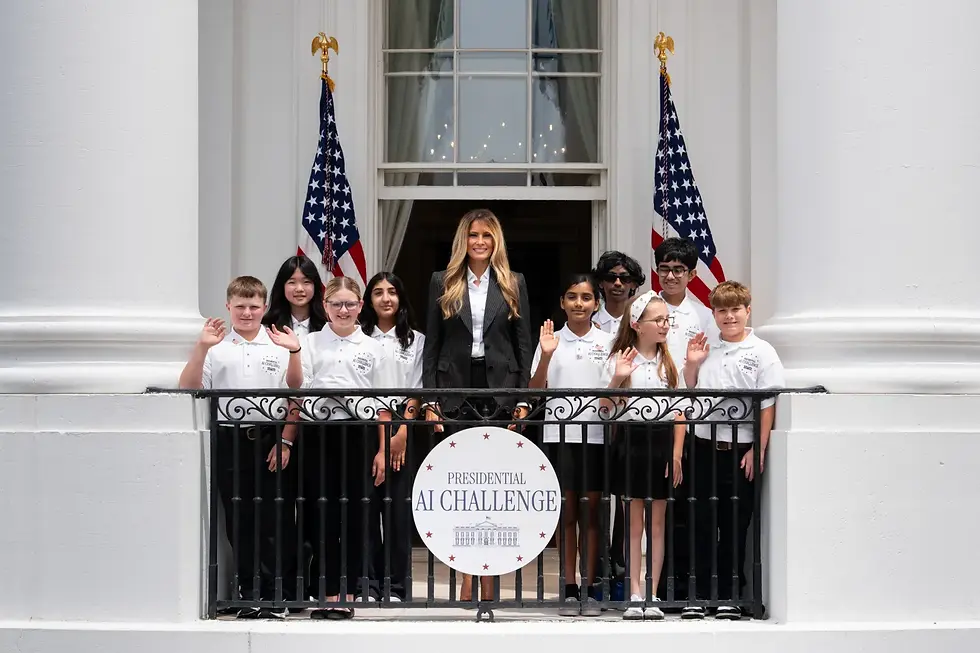
Official White House Photo by Daniel Torok
LOS ANGELES, Oct. 9, 2026 – Seventy-eight percent of the students in the Artificial Intelligence Institute’s classrooms were already using AI before anyone taught them how. Only 13.6 percent had received any guidance.
That is the number education policy has to start from. It is also why the Institute believes President Donald J. Trump is right on AI education: America cannot wait.
In April 2025, the President signed an executive order calling for early AI exposure, educator training, public-private partnerships and an AI-ready workforce. It created a White House Task Force on Artificial Intelligence Education and directed agencies to expand AI-literacy opportunities for students and teachers. First Lady Melania Trump has taken that mission directly to young people through the Presidential AI
Challenge, which recognizes students using AI to solve real-world problems. The administration now calls the technology Super Intelligence. The direction has not changed, and on this issue, it is right: America should lead, not retreat.
The reason is simple. The children are not waiting.
They did not wait for a school-board policy. They did not wait for a federal task force. They did not wait for
parents, teachers or districts. For two years, in our classrooms, students have told us they began using AI as early as second and third grade. We hear it every day.
Access arrived before readiness, and AI can be used in two radically different ways. A student can use it to avoid difficult thinking, handing over the work, the judgment and sometimes the curiosity. Or a student can use it to extend capability: to test an idea, challenge an assumption, verify information and turn a rough thought into something stronger.
The first is cognitive offloading. The second is cognitive amplification. The Institute exists to move students from the first toward the second.
That is why the national debate cannot be reduced to AI in schools versus AI out of schools. Concerns about privacy, safety, academic integrity, dependency and screen time are legitimate, and some of the nation’s largest school systems have moved to restrict student access because of them. But restricting access in school does not remove AI from home. It leaves young people to work it out alone.
The United States is also not making this decision in isolation.
China’s Ministry of Education has already issued national guidance for AI literacy across primary and secondary education. Its approach is developmentally sequenced: awareness in the lower primary grades, understanding and use in later primary and middle school, and more advanced creation and application in high school. In 2026, China released additional structured resources spanning lower primary through senior
secondary education.
America should not respond by racing children toward technology without safeguards.
But neither should it allow caution to become strategic paralysis.
The stronger answer is readiness. Under its President, Dr. Russell Knight, who has spent more than 26 years working on AI and advanced systems at NASA’s Jet Propulsion Laboratory, the Institute built a roughly five-hour, behaviorally structured program around four habits: Think First. Verify Always. Create Originally. Lead With Ethics. The goal is not to teach students to stop asking AI for answers. It is to teach them to walk the path to the answer, so they understand the context and own the result.
The Institute’s own field data, collected over two school years at more than 20 school sites, show what that preparation can change. Students using AI the right way rose from 15.8% to 88%. Students verifying what AI tells them rose from 14% to 89%. Students who knew how to use it safely rose from 14% to 90%. Voluntary attendance rose 10% after the second session. School districts have adopted the program and renewed it
for a second year. The National Science Foundation has expressed interest in the field data, and the Institute is lining up academic partners for independent evaluation.
This is first-party evidence collected in real classrooms, not independent research. The Institute does not claim that five hours creates permanent neurological change. It does claim that structured preparation changes how students approach AI, and it welcomes independent evaluation.
What should the country do with that? Three things, now.
First, teach AI as a behavior, not only a tool. Knowing what AI is matters. Knowing what to do when it is in front of you matters more.
Second, reach students before the habits harden. The students in the Institute’s classrooms were already forming them in elementary school.
Third, measure what works. Federal, state and local leaders should ask every AI education program for evidence of behavior change, not only attendance.
President Trump is right that America should move aggressively toward an AI-ready future. First Lady Melania Trump is right to put young people visibly inside it. Now the country has to finish the job.
The real race is not only to build the smartest machines. It is to raise a generation that becomes more capable because those machines exist and never forgets who is driving.
_______________________________________________________________________
About the Artificial Intelligence Institute
The Artificial Intelligence Institute teaches people across ages, grades and professions how to remain in command of increasingly powerful intelligence systems.
Its proprietary behavioral architecture trains learners to move from cognitive offloading to cognitive amplification, questioning, directing, verifying and controlling the technology rather than surrendering thinking to it.
Think First. AI Helps Second.
The goal: turn advanced intelligence into a personal superpower without surrendering human judgment, authorship or control.
Learn more: artificial-intelligence-institute.com
Follow the Frontier
Follow the Artificial Intelligence Institute on LinkedIn, Instagram and Facebook for Frontier News Desk reporting, field observations, AI-readiness insights and emerging developments in human-AI interaction. LinkedIn:
https://www.linkedin.com/company/ethicalai-institutes/ | Facebook: https://www.facebook.com/profile.php?id=100094622704133
Family First Foundation
The Artificial Intelligence Institute grew from more than two decades of Family First Foundation work with children, families, schools and communities.
Follow Family First Foundation for the human, family and community side of this work and follow the Artificial Intelligence Institute for the frontier of AI readiness and human amplification.
Permission to reprint granted with attribution to the Artificial Intelligence Institute, Frontier News Desk and a link to artificial-intelligence-institute.com.
Media Contact: Richard Awni, Executive Director, Artificial Intelligence Institute | richard@familyfirstamerica.org | 818-726-7207
Artificial Intelligence Institute - Frontier News Desk | artificial-intelligence-institute.com


Comments